Palermo is famous for its markets.
The Mint Shop
Showing posts with label fish. Show all posts
Monday, 30 May 2011
Fish markets in Palermo and Stuffed squids
Monday, 10 January 2011
Coastal flavours - pollock with leeks, potatoes and apples
Monday is a bit like January. Everybody hates it. The weekend is over and works starts again. However, an entire week lies ahead and you can make all your plans for it (I have discovered somebody who even writes up a week meal menu!).
All your good resolutions and propositions waiting for you to be formulated. For this 2011 I have promised myself to:
- stock up a bit more the larder (so that when we want to make ragu' we do have plump tomatoes and do not have to rush to the local Co-op in whatever state we are)
- keep at least one loaf of bread in the freezer for emergencies (like on Sunday evening when the only shop opened at that time would be Tesco and we cannot break our vows on never step in it)
- finish reading the entire recipe so that I know that I have all the ingredients and don't have to rush to Co-op (again!)
- be realistic and grow the vegetables that our little garden can physically sustain forgetting about the rugby pitch-size a' la Nigel Slater. In fact I am proud to say that yesterday we made a concrete plan of what to grow, where and when. Now it is only a matter of going to buy the seeds (only...!).
So Mondays and Januarys can be full of hopes. On a colour scale, both Monday and January are blue. I forgot to list my fifth 2011 resolution: make at least one recipe from one of the trillion cooking magazines which are higgledy piggledy piled up in a corner of the kitchen, and one from a cooking book. In fact this Christmas I got two brand new books - "Ottolenghi, the cook book", and "Gourmet Food for a Fiver" by Jason Atherton.
And that is what I did on Saturday. The fish recipe comes from the Gourmet Food with a few modifications - in fact it is probably more a Threer (i.e. £3!). Which is even better. I give you my version of it.
Pollock with leeks, potatoes, and apples
For 2 people
2 pollock fillets (Sainsbury's basic are perfectly fine)
1 apple (any providing it has a pungent taste)
10 new potatoes or 4-5 medium roasting potatoes
1 leek
2 tbsp white wine
4 tbsp olive oil
1 knob of butter
1 small lemon
2 shallots
1 garlic clove
a handful of parsley
1. Prepare the marinate by mixing the wine, 2 tbsp of oil, the juice of the lemon, chopped parsley, chopped garlic clove, and chopped shallots. Leave it aside for at least 20 minutes
2. Clean, and pat dry the fish fillets and leave them in a cool place (which in our case it's anywhere in the house considering the average temperature). Scrub a couple of tsp of salt on each side of the fillet.
3. Cook the potatoes in salted water.
4. Cut the leek in rings and cook until tender in a knob of butter.
5. Wash the apple and then cut it in four parts and cork it. Without peeling it, slice each quarter reasonably fine. Plunge into water with lemon juice to avoid it darkens up.
6. Heat a tbsp of oil and melt a small knob of butter (together) in a large heavy pan. When it starts fizzling, place the fish fillets and leave them to cook on each side for a couple of minutes.
7. When the fish is almost cooked, drain the potatoes (if they are also cooked!), and remove the leeks from the pan.
8. In a bowl combine the leeks with the potatoes and apples.
9. Arrange each fillet on the serving plate. Cover the fillet with the mix of leeks, potatoes, and apples. Pour some of the marinate over and grate a little bit of black pepper before serving.
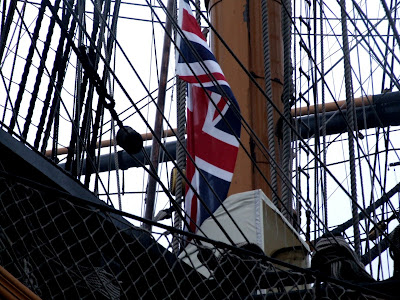
As this book from which the recipe took inspiration was a Christmas present received on the Southern English coast, I thought of sharing with you a few snaps I took while the rest of the family was Sale shopping (can you think of anything worse than fighting with a crazy crowd over post-Christmas leftovers? I can't....).
These are all images from the Victory, the famous ship that was used by Nelson during the battle of Trafalgar in 1805 moored at Portsmouth. Sadly I didn't encounter any Jack Sparrows..
Thursday, 28 October 2010
Moroccan flavours

I've heard many people complaining that in Morocco one finds nothing but couscous and tagines, tagines and couscous. It is true, most of what you get in restaurants do involve one or the other, if not both. But there is more to that. Or at least the flavours can change (a bit) and in any case I love them so much that I really didn't mind!
Morocco has always been a place which has occupied a special fantastical place in my imagination (the real Thousand and One Nights). And when we eventually went, nothing disappointed me. On the contrary, everything was even better than expected. Smells, colours, noises from the market or street vendors, all mix in a grand bazaar.
I cannot deny that there are no annoyances. There are, or better, there can be. But only if you are somebody who starts talking to anyone on the street and starts following him into some remote Berbere market (because of course, everything is Berbere down there, not Arabic) and to some amazingly stinky tanneries.

So what did I cook in the end? Fish Tagine!
This dish is great because you can also prepare it in advance, then simply bang it in the oven and forget about it for at least an hour and even if you leave it there for a bit longer (once you've switched the oven off), that doesn't matter as this even intensifies the flavour.
It is very colourful so always ideal for dinner parties. And if you cook it in the actual tagine itself, you can also serve it straight to the table, removing the lid in front of your guests and expecting a "wow....uhhh".
I had a similar tagine in Essouira. I loved that place. It is so calm and peaceful with white washed houses and blue doors (that blue blows you away), a lively fish market by the port, and a constant breeze blowing over the rampants. If you are in Morocco, do make a detour down there. The impression you will have compared to Marrakesh is totally different. No hassles at shopping and no constant interest from the locals.


We stayed in this lovely guest house right on the cliffs. I had a seagull staring at me for a worrying minute, completely still in the air, while I was eating my semolina pancake (very typical for Moroccan breakfast) with honey. Surprisingly the place was called The Seagull (Dar Al Bahar). Don't leave the place without having savoured a pigeon or prawn pattie (pastilla) or eaten at a fabolous restaurant called Les Alizes' tucked away in a little alley and only lit with candles. Great atmosphere, and not just for the tourists!

Fish Tagine
For 4 people
4 fish fillets (cod or any white fish);
1 tin tomatoes;
1 onion;
2 garlic cloges;
1 tsp cinnamon;
2 tsp cayenne pepper;
2 tsp paprika;
1 tsp cumin powder (I used seeds instead and the result is the same);
3 handfuls of fresh coriander;
2 handful of fresh parsley;
3 tbsp olive oil;
juice of half juice;
4 large potatoes;
2 peppers (red and yellow if possible as it guarantees more colour)
1. In a mortar (or a in a mixer for the modern and busy Berbere dame) mix to a paste all the herbs, garlic, spices and oil. Squeeze the lemon juice and mix well. This is called chermoula.
2. Marinate the fish (cut into 4-5cm long pieces) in the marinade for at least 1 hour (you can make an express tagine and do it even in half an hour if you cook the fish in a pan using a lid to ensure that the flavour intensifies quickly and the fish absorbs it.
3. Chop the peppers and the onion.
4. Peel and slice the potatoes (if you have decided to make the express tagine, then cook the sliced potatoes in boiling and salty water to speed up the cooking time) and place them on the bottom of the tagine or a deep oven tray.
5. Place the peppers, onions, tomatoes on top of the potatoes and then the marinated fish. Cover and place in the oven (if you are using the tagine make sure that it can go into the oven as some of them might crack as they are supposed to be used only on a hob).
6. Cook the dish in the oven for at least 1 hour at 200C. Serve it with couscous which you will have cooked separately in a pan by adding to the grain 2 tsp of salt (for 300g couscous), 1 tsp turmeric, and 1 tsp cinnamon and then covering it with enough boiling water to cover it more than a finger. The coucous must absorb all the water so make sure that the lid is closed and you never peer through. You can add a knob of butter to separate the grains with a fork.
By the way, tagine is, as I am sure you know, being the well-travelled sophisticates that you are, the utensil with the conic hat in which all the ingredients get cooked rather than the dish itself. In Morocco you can find all kid of tagines - sizes, colours, patterns. A tagine for every season.

I've always loved the Yves Rocher bag.
Tuesday, 3 August 2010
Fish cakes in Suffolk

To pay our stay we thought of cooking for R's parents (and use them as our guinea pigs as I hadn't tried this recipe before!). Fish cakes. The combination between the softness of the crab and the sweetness of the salmon with the kick of the horseradish is fantastic. Why is it called horseradish? Horses eat it?....


The recipe would like a couple of chillies but as Russell's mother seems to have an aversion against them, which she justifies with a stomach ache, we decided not to include them. However, please do add one or two (depending on the quantity you are making) as I think they give the cakes that subtle kick that washes your palate off the oiliness of salmon.
For 4 people
Ingredients:
> 200g crab meat (it works also if comes out of a tin); 200g salmon (idem); 1 medium potato; 3 tbsp hand-made mayonnaise (or a good quality one); 2 handful of mixed herbs like dill, parsley, chive; 2 chillies; 2 stbsp of Dijon mustard or 1 tsp of English mustard (English can be so powerful that one tea spoon is more than enough...last time it made me sneeze for 5 minutes!);
> 1 egg yolk; olive oil; half the juice of a lemon; 4 gerkins; fresh horseradish (this might result particularly tricky as it seems that almost no groceries now sell it - if desperate, you can use horseradish from a jar); 1 tpsp capers; salt & pepper.
> 200g spinach;
>200g new potatoes
Preparation:
1. Cook the potato and mash it; mix it with the other ingredients (crab, salmon, chopped herbs, etc) and make some small patties.
2. Make the tartare sauce. Beat the egg yolk adding the juice of the half lemon, and slowly incorporating the olive oil (this can be daunting at first, but all you need to do is to be patient and make sure you drop the oil a little at the time to make sure it is absorbed rather than having two layers of unrelated ingredients!), add a bit of salt and leave to rest. Chop the gerkins, the capers and grate the horseradish, and mix them to the mayonnaise.
3. In the meantime cook the new potatoes aside.
4. Pan fry the cakes until they are gold and crispy, and add a splash of white wine that will evaporate quickly but will leave a nice flavour.
5. When the cakes are almost ready, drop the spinach leaves in a pan of boiling water so that they wilt and they toss them gently in the same pan where the cakes had been cooking until then (you have obviously removed the cakes from the pan!), dressing with some salt and olive oil, and a touch of chilli.
6. Serve the cakes on the plate with the spinach on one side, the new potatoes on the other side (well I leave the artistic arrangement to you), and a generous dollop of tartare sauce on the fish cakes. You can squeeze a little of lemon onto the cakes before eating it.
We ate our fish cakes in the kitchen, perched on metal stalls, and with the windows open, drinking a chilled bottle of Vermentino.

During our mini-holiday on the Sussex coast, I decided once more to try to read "The Sea, the Sea" by Iris Murdoch. I must confess that if you go over the first 200pages when the main character describes in detail his meals, you will not put it down until you have finished!
It is the diary that a retired play-writer and theatre director, Chalres Arrowby, writes at his house by the sea, "Shruff End", which is dilapidated and with no electricity. But it is remote enough for him to enjoy a quite life and escape the glitzes of the West End ; at least this is what he wrongly thinks as a steady stream of visitors, mostly non gratiae, crowd his place.
The book is captivating, vivid, and a real page turner. I found it quite hilarious, if not grotesque at times, with some over-dramatic scenes. I liked how Charles Arrowby slowly realises that he was drawn to the sea as the mother of all nature, calming and soothing as he is in search of a banal, quite life; however, until one has not accepted oneself, the surrounding nature will only mirror inner feelings of those who are plunged in it. And so does Iris Murdoch's sea. It becomes absorbing and dangerous, until Charles has accepted that after all quietness comes with acceptance and contempt of what is owned.
I liked particularly this short description of the sea:
"the sea is noisier today and the seagulls are crying. I do not really like silence except in the theatre. The sea is agitated, a very dark blue with white crests."

If you happen to be on the Sussex coast, I would suggest to visit Bosham.
Ahh the pronunciation is important! It is not, as you would expect, Bosham with aschh sound but Bosham with a som sound, effectively as if you were sayingbosom! I remember it as R's parents made me repeate the word at least five or six time...it is the way people from Sussex pronounce it!

It is true that it consists of only three roads, a church, and a little port with its front, but the whole atmosphere is so retro and stylish that makes you feel like eating scallops with a spoon and buying a fishing net to catch crabs with the children perching over the commons' wall.

You might even end up there when that magnificent house overlooking the estuary is on sale....good luck!
Subscribe to:
Posts (Atom)